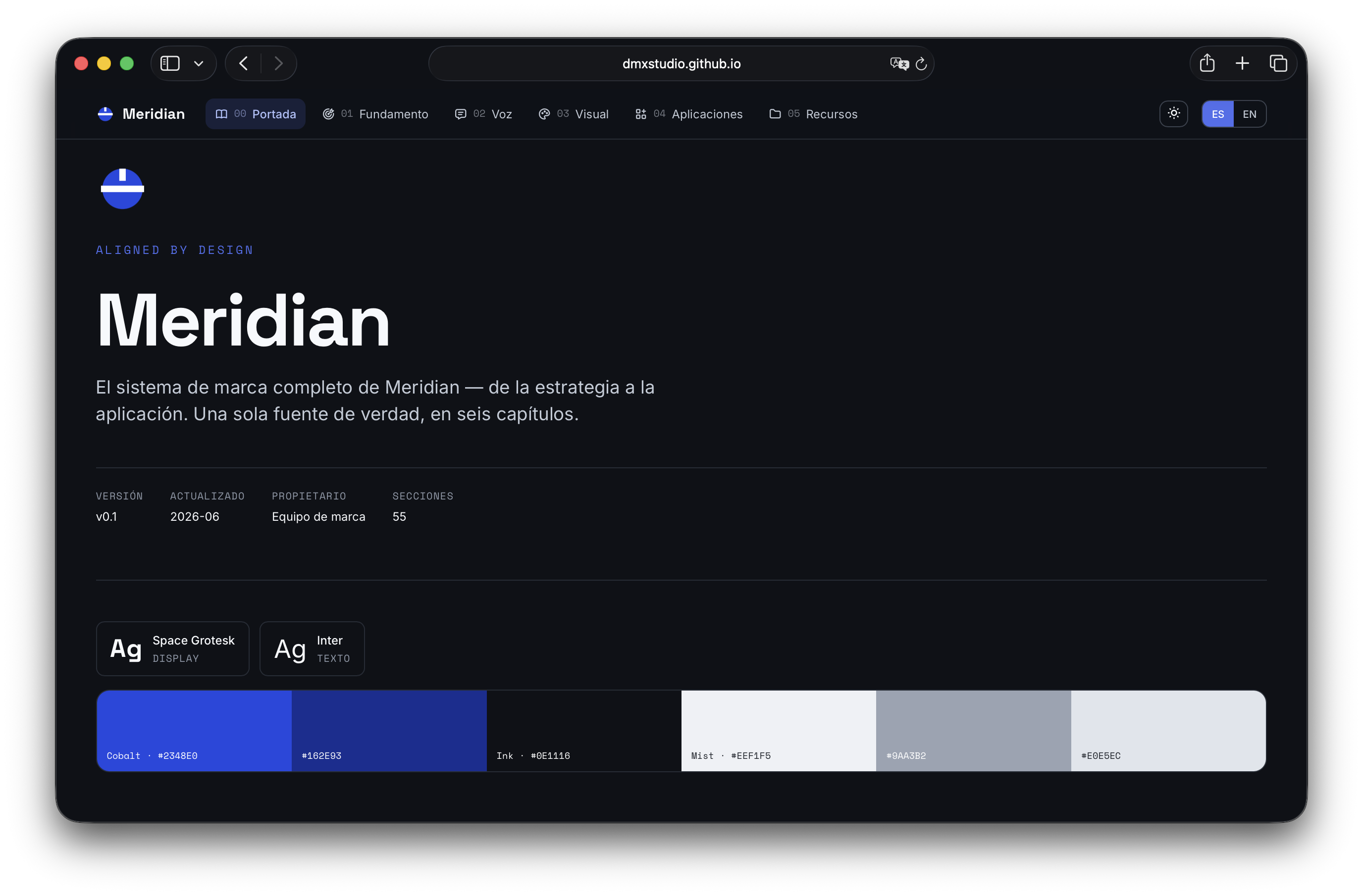
What it is
Brand book that turns identity into rules usable by humans, product teams and agents.
How it works
The template organizes the brand into six areas: cover, strategic foundation, voice, visual identity, applications, resources and governance. Each section has bilingual structure, navigation, downloadable resources and a machine-readable catalog that can be mapped to fields, validations or automations.
The intent is to turn brand guidelines into a useful production layer: tokens, voice rules, assets, formatting conventions, llms.txt, AGENTS.md and JSON files that can feed AI-assisted design workflows without losing human review.
Learnings
Consistency improves when brand exists as data, tokens and actionable criteria.
State
Public, portable template in static HTML, CSS and JS. It includes a bilingual demo, light/dark mode, printable structure, W3C tokens, Tailwind preset, agent guidance, llms.txt, a machine-readable catalog and downloadable assets.
Problem it solves
Brands often live in documents designed for human reference, while teams now produce interfaces, content and campaigns with AI-assisted tools. The result can become inconsistent: scattered prompts, visual decisions without traceability and brand rules that are hard to apply in production.
Branding AI Guidelines proposes a middle layer: a guide that remains editorially clear for brand owners while exposing the data design agents need to work with explicit limits, tokens and rules.
Product approach
The work was not limited to laying out a brand book. The template is designed as a reusable system: multi-page, bilingual, responsive, printable and build-free so it can be hosted or versioned easily.
Each section works as brand content and as a structural unit. IDs, bilingual names, tiers, media types and deliverables are documented in a machine-readable catalog, which makes it possible to connect the guide to CMSs, validators, automation workflows or design agents.
Brand data for agents
The guide includes resources designed for AI systems: AGENTS.md with operating rules for coding and design agents, llms.txt with brand context, W3C tokens, a Tailwind preset, data formats, voice rules and downloadable assets.
This allows an agent to avoid “interpreting” the brand from a screenshot or PDF and instead read its foundations, constraints and resources as structured inputs.
Visual and product consistency
The structure covers strategic foundation, voice, visual identity, applications and governance. It does not separate “brand” from “product”: tokens, typography, color, tone, demo components and formatting conventions live within the same framework.
For digital products, that decision matters because consistency is not only aesthetic. It depends on design, copy, data and automation sharing the same brand definition.
Governance ready for operations
The template distinguishes essential, recommended and advanced content. It also declares which sections require media, which deliverables are expected and which resources are available for download.
This makes the guide easier to audit: a brand owner can review what is missing, a product team can identify which rules to apply and an agent can consume the information without relying on ambiguous instructions.