Studio role
UX strategy, passenger journey architecture, product design, UI design, design system, usability testing and POC handoff.
Context
Aeroméxico aimed to explore a fully digital and contactless air-travel journey, where facial recognition could work as the authentication method across key journey touchpoints: purchase, check-in, lounge access and boarding.
The project was developed as a proof of concept. The opportunity was not only to incorporate biometrics, but to define how a travel experience should feel, explain itself and operate when identity, security, speed and trust coexist in every interaction.
Challenge
Design a contactless biometric journey connecting purchase, check-in, lounge and boarding without breaking trust.
Objective
The business objective was to explore a differentiated experience for the airline industry, with the potential to reduce operational friction and improve journey continuity.
From an experience perspective, the objective was to design a journey where passengers understood when, how and why their biometric identity was being used. From a product perspective, the goal was to validate a technically viable POC prepared to evolve toward MVP.
From design, the focus was to create a clear system for multiple touchpoints while maintaining consistency, perceived security and user control.
Approach
Workshops, research, journey architecture, prototypes, design system and testing to validate the POC.
Solution
The solution framed passenger identity as the connective layer of the travel journey. Instead of treating biometrics as an isolated screen, the system integrated it as an authentication layer distributed across critical moments.
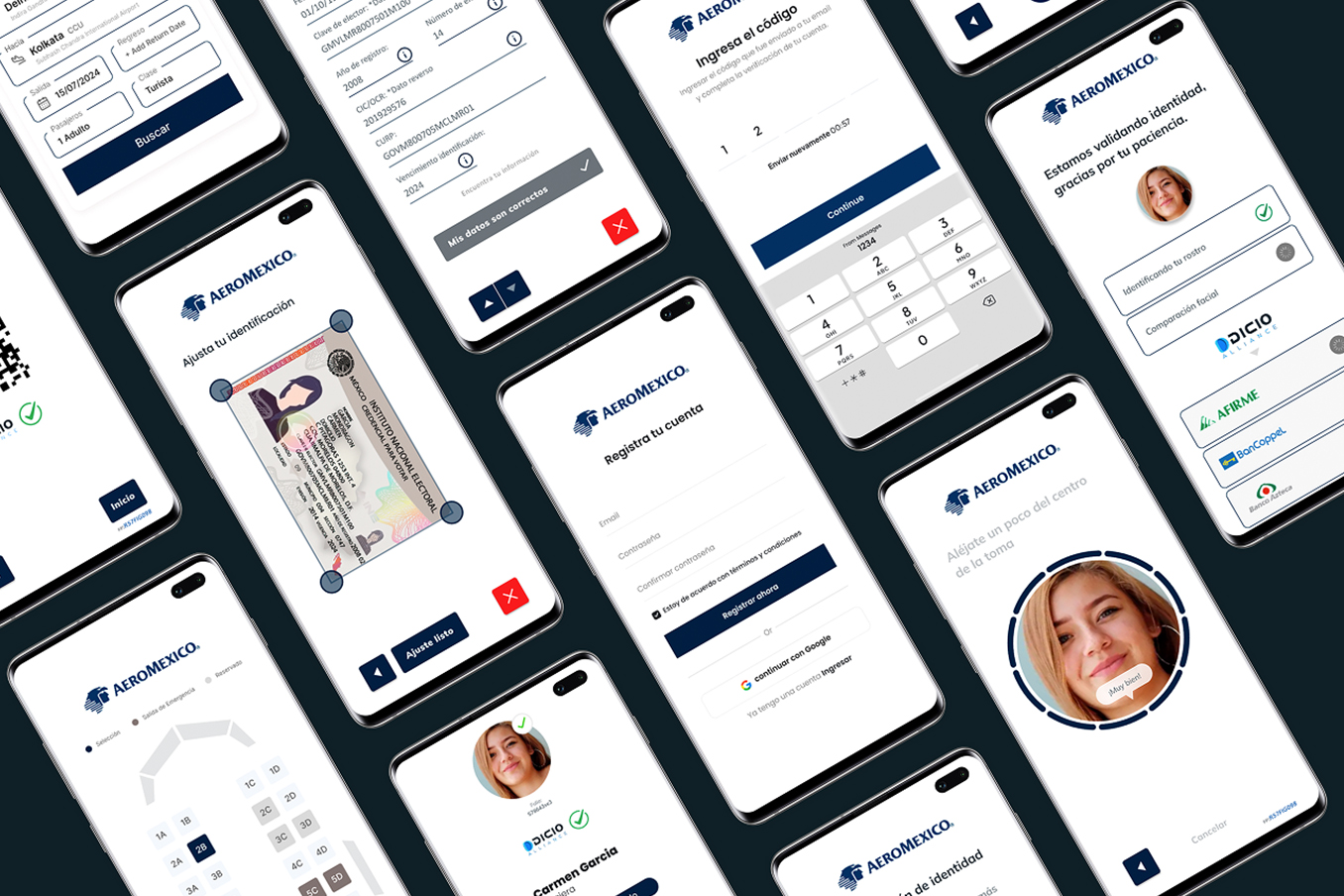
The experience was designed to explain each step, request consent clearly, reduce uncertainty and keep process status visible. The visual and component system organized screens, states, messages and validation points so the pilot could be tested as a coherent end-to-end experience.
Proposed KPIs
Recommended indicators for this type of experience include check-in time, boarding time, biometric enrollment rate, capture errors, drop-off by step, use of manual alternatives, recovery after error, passenger satisfaction and operational load at service points.
The time reduction is presented as a projection associated with the POC, not as a final result from public operation.
Deliverables
The project included strategic workshops, benchmarking, research, journey architecture, UX flows, wireframes, prototypes, final UI, design system, component library, usability testing and documentation for proof-of-concept handoff.
Results
The proof of concept helped validate the logic of a biometric travel experience and established a scalable base to move toward MVP.
The work defined a clearer journey for passengers and operations: less dependency on physical documents at critical points, greater continuity between steps and an architecture prepared to incorporate new phases without redesigning the base experience.
Expected impact
The expected impact related to making critical travel moments more fluid, reducing physical contact, lowering friction in validations and establishing a scalable experience base for future product phases.
Beyond efficiency, the strategic value was in showing how an airline can design digital identity as part of the service, not as a separate technical requirement.
Learnings
Biometrics does not become trustworthy by being invisible. In travel, trust appears when passengers understand what is happening, why their identity is requested and what comes next.
Multi-touchpoint journey
The work connected moments that usually live separately: purchase, identity enrollment, check-in, lounge and boarding. Each point required a different decision around information, consent, confirmation, error and recovery.
The journey architecture helped define what passengers needed to know at each moment and what the system had to solve to maintain continuity. The goal was to avoid a fragmented experience where each validation felt like a new procedure.
Explainable biometrics
A key decision was not to hide biometrics behind technological magic. The experience had to explain capture, anticipate questions, communicate status and show alternatives when something did not work.
This led to work on microcopy, states, confirmations, errors, permissions and supporting messages. Biometrics had to feel fast, but also readable and trustworthy.
Visual system and validation
The design was organized through reusable patterns for screens, validation states, instructions, feedback and decision moments. This allowed the POC to grow without treating each touchpoint as an exception.
The process included prototypes and usability testing to refine the flow before implementation, with special attention to clarity, perceived security and ease of progression.
A contactless journey is not designed by removing steps, but by making identity, context and trust move together.DMX Studio
Gallery